
The way people pay for products and services has changed significantly with the growth of digital commerce in India. From scanning QR codes at local shops to purchasing smartphones through mobile apps, consumers now expect payment options that are quick, convenient and flexible. One financial service that has attracted attention in this changing landscape is , commonly known as BNPL.
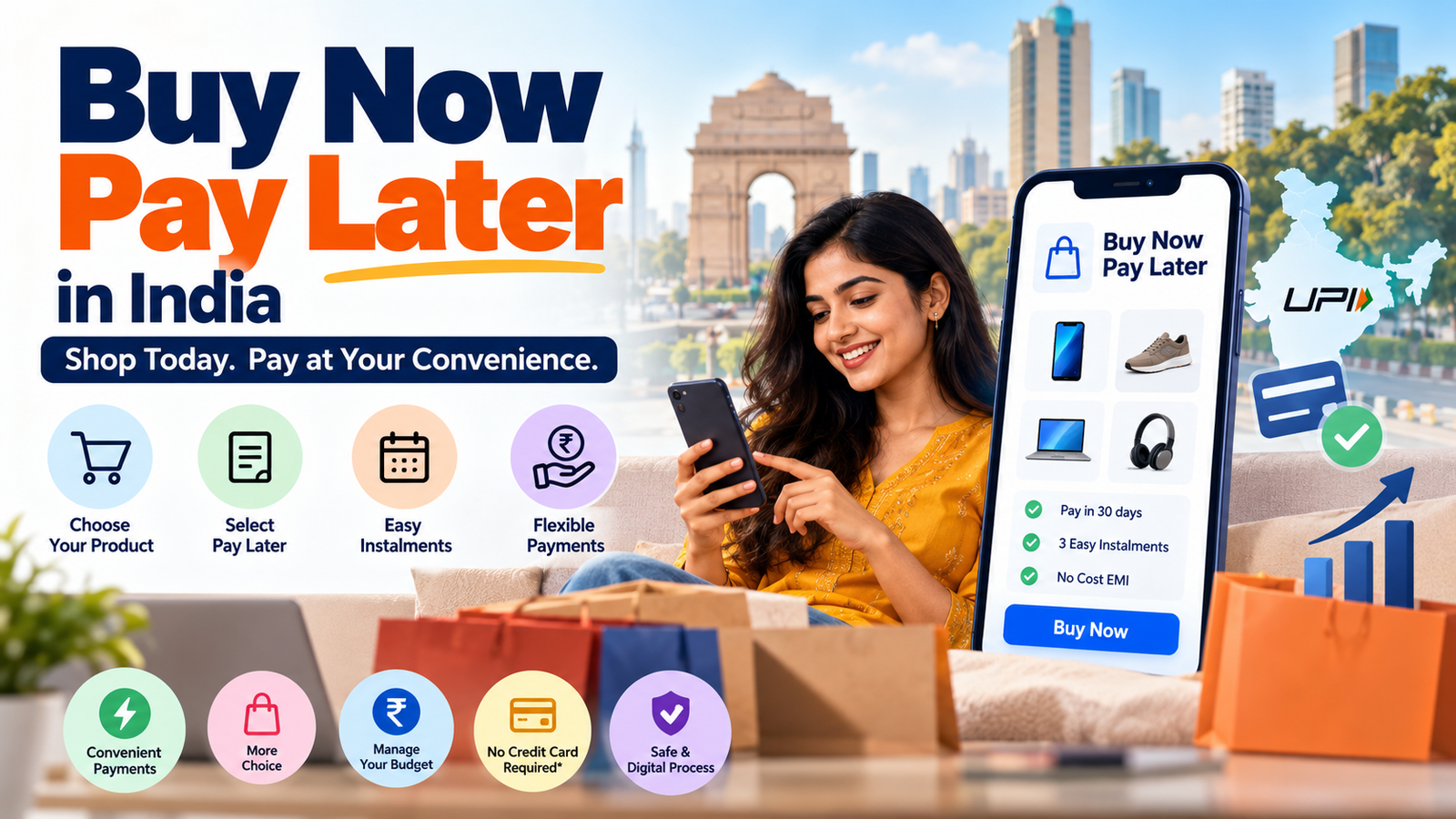
Buy Now Pay Later allows eligible customers to purchase products or services immediately and pay the amount at a later date or through instalments. Instead of paying the entire purchase price upfront, customers can spread their payments according to the terms offered by a participating provider.
The concept may sound simple, but BNPL involves more than just delaying a payment. It brings together digital payment platforms, merchants, banks, non-banking financial companies (NBFCs) and fintech businesses. Its growth also raises important questions about borrowing costs, credit scores, consumer protection and responsible spending.
What Is Buy Now Pay Later?
Buy Now Pay Later (BNPL) is a payment arrangement that gives eligible customers access to a deferred-payment or credit facility when making a purchase. The customer receives the product or service and repays the amount according to an agreed schedule.
For example, imagine someone wants to buy a smartphone priced at ₹20,000 but does not want to pay the entire amount at once. If an eligible BNPL provider offers four instalments without additional charges, the customer could pay ₹5,000 per instalment.
The total repayment in this example would remain ₹20,000, provided no additional fees or interest apply.
However, not every BNPL plan is interest-free. Some providers offer short repayment periods, while others provide instalment-based financing that may include interest, processing fees or late-payment charges.
This is why customers should always read the repayment terms before accepting a BNPL offer.
How Does Buy Now Pay Later Work in India?
The BNPL process is generally designed to make checkout easier. Customers can select an available payment option and complete the required eligibility checks without necessarily applying for a traditional credit card.
The exact process depends on the provider and the underlying credit arrangement.
1. Select a product or service
The customer visits an online shopping platform or a participating merchant and selects a product, such as a smartphone, appliance, clothing item or household essential.
2. Choose the BNPL payment option
At checkout, the customer selects Buy Now Pay Later if the facility is available for that transaction. The provider displays the applicable payment schedule and other conditions.
3. Complete the eligibility assessment
The provider or its lending partner may check the customer's identity, credit history, repayment capacity and other eligibility criteria. Approval is not guaranteed.
4. Complete the purchase
Once the transaction is approved, the merchant processes the order. Depending on the arrangement, the merchant receives settlement from the lender or payment partner.
5. Repay the outstanding amount
The customer repays the amount according to the agreed deadline or instalment schedule. Missing payments may lead to additional charges and, where applicable, adverse credit reporting.
In India, the fintech brand shown at checkout may not be the actual lender. Customers should check the loan agreement to identify the bank or NBFC providing the credit.
Major Buy Now Pay Later Services in India
India's BNPL ecosystem has included fintech companies, e-commerce platforms and bank-backed credit products. However, product availability changes over time, and a service that was available in the past may no longer accept new customers or may have different eligibility conditions.
Some notable names associated with this market include:
Amazon Pay Later: A deferred-payment facility for eligible Amazon customers, subject to the current product terms and lending arrangements.
LazyPay: A digital credit and payment service associated with short-term credit and merchant checkout options.
Flipkart Pay Later: A service historically associated with deferred payments for eligible Flipkart customers. Its current availability should be verified.
Paytm Postpaid: A postpaid payment offering associated with the Paytm ecosystem, subject to the availability and terms of the applicable product.
Bank-backed credit facilities: Banks may offer short-term credit, credit lines or EMI products that provide some similar benefits, although their structure can differ from fintech BNPL.
These services should not be treated as interchangeable. Before applying, customers should verify the current offer, the identity of the lender, the repayment period and all applicable charges.
Different Types of BNPL Payment Models
Buy Now Pay Later is a broad term covering several payment arrangements. Understanding the differences can help customers select the option that best fits their financial situation.
BNPL modelHow it worksPay next monthThe customer pays the outstanding amount on a specified future date.Short-term instalmentsThe purchase amount is divided into a small number of payments.EMI financingThe customer repays the financed amount through monthly instalments over an agreed period.Credit line linked to UPIAn eligible credit facility can be used through supported UPI payment channels.Merchant-provided deferred paymentA merchant allows payment at a later date under its own commercial terms.Although these options can serve similar purposes, their legal and financial structures may differ. In particular, a credit line accessed through UPI is not the same as an ordinary UPI payment made directly from a bank account.
Buy Now Pay Later vs UPI, Credit Cards and EMI
India already has several convenient payment methods. BNPL is different because it can introduce a borrowing arrangement into the purchase process.
BNPL vs UPI: A normal UPI transaction generally transfers money from the customer's linked bank account. BNPL allows payment to be deferred when the customer has access to an eligible facility.
BNPL vs credit cards: Credit cards provide a revolving credit facility with a statement and payment due date. BNPL may offer transaction-specific credit or short-term payment arrangements. Both can involve charges if the customer does not follow the repayment terms.
BNPL vs EMI: EMI is a repayment structure in which the financed amount is paid in instalments. BNPL may offer EMIs, but some products instead require a single payment at a later date.
The most suitable option depends on the total cost, repayment period, eligibility requirements and the customer's ability to pay on time.
Benefits of Buy Now Pay Later in India
The appeal of Buy Now Pay Later comes from its convenience. When used carefully, it can help customers manage planned purchases without making the entire payment immediately.
Convenient digital payments
Many BNPL products integrate directly into online checkout systems. Eligible customers can choose the payment method without going through the process of applying for a conventional credit card.
Flexibility for planned purchases
A deferred-payment option may help a customer spread the cost of an essential purchase across several paydays, provided the repayment schedule fits the household budget.
More payment choices for consumers
BNPL gives eligible customers another way to pay, including some people who do not have a traditional credit card. Approval and eligibility requirements still apply.
Potential benefits for merchants
Offering additional payment options may help online retailers improve checkout completion and attract customers who prefer instalments or deferred payment.
Digital-first experience
The application, approval and repayment process may be managed through a mobile application or online platform, making it easier to monitor transactions and due dates.
These advantages do not mean that BNPL is automatically the cheapest or safest option. Customers should compare the complete cost before choosing a payment method.
Risks and Disadvantages of BNPL
The convenience of deferred payments can make it easier to spend more than planned. A purchase may appear affordable when viewed as a small instalment, even when the total amount is difficult to repay.
Late-payment charges
Missing a due date may result in late fees, interest or other consequences specified in the agreement.
Impact on credit history
Some BNPL arrangements are reportable credit products. Missed repayments or defaults may affect the customer's credit profile. Customers should not assume that short-term credit is invisible to credit bureaus.
Overspending and multiple debts
Using several BNPL services simultaneously can create multiple repayment obligations. Small instalments can accumulate into a substantial monthly commitment.
Fraud and data privacy
Customers should avoid unverified lending applications, carefully review permissions and verify the lender before sharing identity documents or financial information.
Repayment pressure
BNPL does not eliminate the cost of a purchase. It moves the payment obligation into the future, when the customer may have other bills or financial commitments.
A sensible approach is to use BNPL only for planned purchases that can be repaid comfortably from expected income.
RBI Regulations and the Legal Framework for BNPL in India
The regulatory framework is an important part of understanding Buy Now Pay Later in India. BNPL is not governed by one standalone law covering every possible payment arrangement. The applicable requirements depend on the product's structure and the entities involved.
The Reserve Bank of India (RBI) regulates banks and NBFCs and has established rules for digital lending, including the Digital Lending Directions, 2025.
Important areas of the regulatory framework include:
Transparent loan terms: Customers should receive applicable information about interest, fees, penalties and repayment obligations.
Lender identification: Customers should be able to identify the regulated entity providing the credit.
Key Fact Statement: Covered digital loans require a standardised disclosure of key loan terms and costs.
Data protection: Customer information must be handled according to the applicable regulatory requirements.
Credit reporting: Qualifying credit facilities are subject to applicable credit-information reporting rules.
Grievance redressal: Customers should have access to the appropriate complaint-handling process.
Customers can consult the Reserve Bank of India website for official notifications and consumer guidance.
Regulatory compliance should not be confused with an endorsement of a particular BNPL brand. Before accepting a loan, customers should verify the lender and read the applicable agreement.
How Do BNPL Companies Make Money?
The business model of a BNPL company depends on whether it acts as a lender, a technology provider, a payment intermediary or a combination of these roles.
Merchant transaction fees
A merchant may pay a fee to offer BNPL at checkout. The arrangement can help the merchant provide flexible payment choices, while the provider earns revenue from facilitating the transaction.
Interest and financing charges
Some credit-based products generate interest income or other permitted charges. Others advertise interest-free repayment plans for eligible transactions.
Technology and servicing fees
A fintech company may earn revenue by providing checkout technology, customer acquisition, payment processing or loan-servicing support to a lender or merchant.
Commercial partnerships
BNPL businesses may work with e-commerce platforms, retailers and financial institutions. Revenue depends on the terms of these partnerships and the services provided.
The business must also manage funding costs, fraud, defaults, customer support, technology expenses and regulatory compliance. Consequently, high transaction volumes do not automatically translate into profitability.
Example: How a BNPL Transaction Works for a Merchant
Consider an online retailer selling a product for ₹5,000. Suppose its agreement with a BNPL provider includes a hypothetical merchant fee of 3%.
Transaction detailAmountProduct selling price₹5,000Merchant fee at 3%₹150Illustrative settlement before other adjustments₹4,850In this example, the merchant receives ₹4,850 before other adjustments, assuming the fee is deducted from the settlement. The customer may still owe ₹5,000 to the lender, depending on the agreement.
The merchant fee is not necessarily the BNPL company's net profit. The provider must account for its own operating expenses, funding costs, credit losses and other obligations.
Actual fees and settlement arrangements vary by provider and merchant contract.
Opportunities for BNPL in India's E-commerce Industry
India's growing digital commerce market provides opportunities for businesses that want to offer more flexible payment options. BNPL may be relevant to several sectors, depending on the availability of suitable financing partners.
Online retail
Electronics, fashion, appliances and other online retail categories may benefit from additional checkout options, particularly for planned purchases.
Grocery and essential goods
Some providers may support eligible transactions involving groceries and everyday products. However, the suitability of short-term credit for routine household spending should be considered carefully.
Travel and hospitality
Eligible financing options may be offered for certain travel bookings, depending on merchant and lender arrangements.
Education and services
Some businesses may explore financing partnerships for eligible services where the provider's credit policies and repayment terms are appropriate.
Business-to-business commerce
Businesses may use related forms of trade credit or invoice financing to manage working capital. These are not necessarily consumer BNPL products and may operate under different commercial and regulatory arrangements.
For merchants, the decision to introduce BNPL should be based on customer demand, transaction costs, settlement terms, refund handling and the potential impact on sales.
The Future of Buy Now Pay Later in India
The future of BNPL will depend on the balance between consumer convenience, responsible lending and sustainable business economics.
Several developments are worth watching.
Integration with digital commerce: Payment options may become more closely integrated with merchant checkout experiences, making it easier for eligible customers to compare payment methods.
Credit-enabled digital payments: Credit facilities linked to supported payment channels may create additional ways to finance purchases. These remain distinct from ordinary bank-account payments.
Stronger lending safeguards: Regulatory requirements around disclosure, customer data, creditworthiness and recovery practices will remain important to the sector.
Improved fraud detection: Digital lenders and payment providers have incentives to strengthen identity checks and monitor suspicious transactions.
Greater focus on repayment capacity: Responsible providers need to consider whether customers can afford their obligations rather than focusing exclusively on transaction growth.
The long-term success of Buy Now Pay Later in India will depend on whether providers can offer transparent products, manage credit risks and build lasting customer trust.
Frequently Asked Questions About Buy Now Pay Later in India
Is Buy Now Pay Later legal in India?
BNPL is not categorically prohibited in India. Credit-based products must comply with the applicable regulatory framework, depending on their structure and the entities involved.
Does BNPL affect a CIBIL score?
It can. When a BNPL facility is reported as credit, repayment history and defaults may affect the customer's credit profile. Customers should check the provider's disclosures.
Is BNPL interest-free?
Not always. Some plans may offer interest-free periods, while others include interest, processing fees or late-payment charges.
Can I use BNPL without a credit card?
Some providers offer credit facilities without requiring an existing credit card. Customers must still satisfy the applicable eligibility and verification requirements.
What happens if I miss a BNPL payment?
Depending on the agreement, the customer may face late charges, collection activity and adverse credit reporting. Contacting the lender promptly is advisable if repayment becomes difficult.
Is BNPL the same as a credit line on UPI?
No. A credit line on UPI uses an eligible credit facility through supported UPI channels. An ordinary UPI payment generally transfers funds from a linked bank account.
How can I choose a safe BNPL provider?
Verify the lender, review the repayment schedule, check all applicable fees, read the loan agreement and use official customer-support channels. Do not assume that an application is safe simply because it appears in an advertisement or app listing.
Conclusion
Buy Now Pay Later in India reflects a broader shift towards digital payments and flexible consumer credit. It can offer convenience to eligible customers and give merchants another way to support purchases, but it also introduces financial obligations that should not be overlooked.
For consumers, the priority should be understanding the total repayment amount and choosing a schedule they can afford. For merchants, the important considerations include transaction fees, settlement reliability, customer experience and regulatory compliance.
BNPL can be a useful financial tool when used responsibly. Its value, however, depends on transparent terms, suitable credit assessments and customers who understand that paying later still means paying in full.