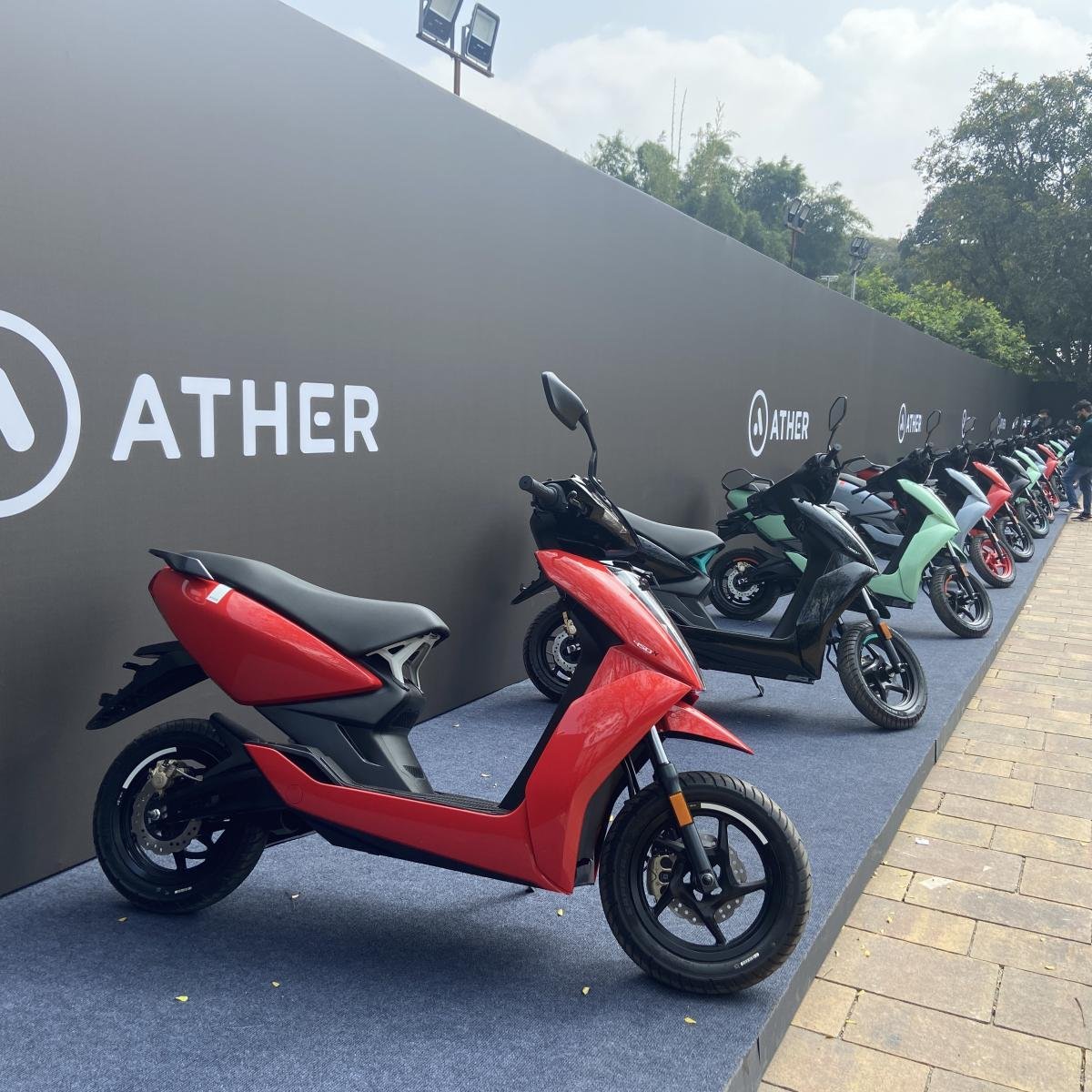
Ather Energy Limited is an Indian electric mobility company that develops electric scooters, connected vehicle technologies and charging infrastructure. Founded in 2013, the company has built its business around the idea that electric mobility involves more than replacing a petrol engine with a battery. Its approach combines vehicle engineering, software, charging solutions and after-sales support to create a more integrated ownership experience.
Headquartered in Bengaluru, Karnataka, Ather Energy has established a presence in India's electric two-wheeler market through its Ather 450 and Ather Rizta product families. While the 450 range focuses on performance and technology, the Rizta is designed for everyday commuting and family use. The company is also developing new vehicle platforms and expanding its manufacturing and retail capabilities to support future growth.
Ather Energy's business is particularly notable for its focus on product development and its investment in infrastructure around electric scooter ownership. Its long-term challenge is to convert growing sales and an expanding customer base into sustainable profitability in a competitive market.
Company Profile
Company name: Ather Energy Limited
Brand name: Ather Energy
Founded: 2013
Founders: Tarun Mehta and Swapnil Jain
Headquarters: Bengaluru, Karnataka, India
Industry: Automotive and electric mobility
Primary business: Electric two-wheeler manufacturing
Key products: Ather 450 and Ather Rizta
Charging network: Ather Grid
Manufacturing presence: Hosur, Tamil Nadu
Stock exchanges: National Stock Exchange (NSE) and Bombay Stock Exchange (BSE)
NSE ticker: ATHERENERG
Official website: https://www.atherenergy.com
History and Development of Ather Energy
Ather Energy was founded by Tarun Mehta and Swapnil Jain in 2013 with the aim of developing electric vehicles suited to Indian consumers. From its early stages, the company placed considerable emphasis on engineering, battery technology, vehicle software and the overall riding experience.
The launch of its first production electric scooters helped establish Ather as a technology-focused participant in the Indian electric two-wheeler industry. Instead of relying exclusively on external charging infrastructure, the company also developed its own charging ecosystem to make electric scooter ownership more convenient.
As the market evolved, Ather broadened its product strategy. Its 450 series served riders seeking performance-oriented electric scooters, while the Rizta introduced a more practical design aimed at families and everyday commuters. This expansion allowed the company to address a wider range of customer requirements.
The company subsequently strengthened its retail and service presence, invested in manufacturing capacity and entered the public markets in May 2025. These developments marked an important stage in its transition from a specialised electric scooter manufacturer to a larger electric mobility business.
Ather Energy's Business Model
Ather Energy follows an integrated electric mobility business model. Its core activity is the development and sale of electric scooters, supported by charging facilities, software features, accessories, spare parts and after-sales services.
1. Electric scooter manufacturing and sales
Vehicle sales are the foundation of Ather Energy's business. The company develops electric scooters for different customer segments, from performance-oriented riders to families seeking practical daily transportation.
Revenue from this activity depends on the number of vehicles sold, the average selling price, the product mix and the company's ability to manage manufacturing and distribution costs. A growing sales base can improve factory utilisation and spread certain fixed costs across more vehicles.
2. Software and connected services
Ather incorporates digital technology into its scooters through connected features, vehicle interfaces, navigation-related functions and software-based capabilities, depending on the model and subscription package.
Certain digital features and services can generate recurring revenue. They also help the company maintain a continuing relationship with customers after the original vehicle purchase.
3. Charging infrastructure
Ather Grid is the company's charging network, designed to support electric scooter users through compatible charging facilities. Charging infrastructure is an important part of the wider ownership proposition because access to convenient charging can influence a buyer's decision to switch from a petrol scooter.
The network also supports the company's broader electric mobility strategy. Its commercial contribution depends on charging usage, network utilisation, operating costs and expansion requirements.
4. Accessories and spare parts
The company sells scooter-related accessories and replacement parts. These products can contribute additional revenue throughout a vehicle's ownership period, while giving customers access to products designed for compatibility with their scooters.
5. Servicing and after-sales support
Electric scooters still require inspection, maintenance, repairs and replacement components. Ather's service network helps support customers after purchase and provides another point of contact between the company and its existing customer base.
A broader service footprint can improve customer convenience, although it also requires investment in facilities, equipment, staff and spare-parts availability.
6. Retail and distribution
Ather uses Experience Centres and other retail channels to introduce customers to its products, facilitate test rides and support sales. Its retail and service expansion helps the company reach customers beyond its established markets.
The effectiveness of this model depends on choosing suitable locations, generating sufficient sales per outlet and keeping the cost of customer acquisition and distribution under control.
How the business model creates value
Ather's strategy is to combine vehicle sales with services and infrastructure that remain relevant throughout the customer's ownership period. Vehicle sales bring customers into the ecosystem, while software, accessories, charging and servicing create opportunities for additional revenue and stronger customer engagement.
The central financial objective is to grow sales without allowing manufacturing, research, retail expansion and service costs to rise faster than revenue over the long term.
Ather Energy's Main Products
Ather 450 Series
The Ather 450 series represents the company's performance-oriented electric scooter range. These scooters are designed for customers who value acceleration, handling, digital features and a technology-focused riding experience.
The range has played an important role in establishing Ather's identity as an engineering-led electric vehicle brand. Depending on the variant, features and specifications can differ in areas such as performance, battery capacity, range, charging and connected technology.
Ather Rizta
The Ather Rizta is a family-oriented electric scooter developed for everyday transportation. Its design and positioning emphasise comfort, practicality, storage and ease of use rather than focusing exclusively on sporty performance.
The Rizta is strategically important because it allows Ather to compete for customers who may prioritise household convenience, commuting and general-purpose transportation. Its contribution to the company's sales growth demonstrates the importance of offering products suited to different usage patterns.
Ather Grid
Ather Grid is the company's electric vehicle charging network. It supports the broader ownership ecosystem by providing charging options for compatible electric two-wheelers.
The development of a reliable charging network can help reduce concerns about access to charging facilities. However, the network's long-term economics depend on customer usage, operating expenses, site availability and continued infrastructure investment.
Connected technology and accessories
Ather's wider product ecosystem includes software-enabled features and vehicle accessories. These offerings complement its electric scooters and help extend the relationship between the brand and its customers beyond the initial sale.
The precise features available depend on the vehicle model, hardware configuration, software version and applicable subscription arrangements.
Latest Financial Performance of Ather Energy
Ather Energy's financial performance shows a business experiencing rapid expansion while working to improve its operating economics. The company reported strong annual growth in FY2025–26 and a significant improvement in its results during the first half of FY2026–27.
FY2025–26 annual results
For the financial year ended 31 March 2026, Ather Energy reported total income of ₹3,823 crore, representing an increase of approximately 66% over the previous financial year. The company sold 262,942 electric scooters during the year, up approximately 69% year on year.
Adjusted Gross Margin reached ₹925 crore, an increase of approximately 116% compared with the previous year. The company also reported an improvement in its adjusted gross margin as a proportion of total income.
These results reflected higher sales volumes, the contribution of the Rizta range, wider retail distribution and improvements in the company's product mix and cost structure.
However, growth did not yet translate into full-year net profitability. Ather reported a net loss of approximately ₹517 crore for FY2025–26.
FY2026–27 first-quarter performance
In the quarter ended 30 June 2026, Ather Energy reported revenue from operations of approximately ₹1,216.9 crore, compared with ₹644.6 crore in the corresponding quarter of the previous year.
The company delivered 83,173 scooters during the quarter, representing growth of approximately 80.5% year on year. Its net loss narrowed to around ₹51.1 crore from approximately ₹178.2 crore in the year-ago period.
One of the key developments was the company's reported positive EBITDA of approximately ₹9 crore. EBITDA measures earnings before interest, taxes, depreciation and amortisation; it is useful for assessing operating performance but does not represent net profit or cash flow.
Second-quarter results: September 2026
Ather Energy's results for the quarter ended 30 September 2026 marked a further improvement in its reported financial performance.
Financial metricQ2 FY2026–27Revenue from operations₹1,464.2 croreTotal incomeApproximately ₹1,527 croreTotal expensesApproximately ₹1,526 croreNet profitApproximately ₹1.5 croreRevenue growth year on year62.9%Revenue from operations increased from ₹898.9 crore in the corresponding quarter of the previous financial year. On a sequential basis, revenue grew from approximately ₹1,216.9 crore in Q1 FY2026–27.
The company reported its first quarterly net profit in this period. This is an important milestone, but the result should be considered alongside its operating expenses and the contribution of other income. Total expenses remained substantial, and operating revenue was below total expenses for the quarter.
Consequently, one profitable quarter does not by itself establish that Ather has achieved sustained profitability across its business cycle.
Financial performance at a glance
- Reporting period Revenue from operations Net result
- FY 2025–26: ₹3,671.8 crore Loss of approximately - ₹517 crore Q1
- FY 2026–27: ₹1,216.9 crore Loss of approximately - ₹51.1 crore Q2
- FY 2026–27: ₹1,464.2 crore Profit of approximately - ₹1.5 crore
- Figures are rounded where appropriate. FY 2025–26 total income was ₹3,823 crore, which is different from revenue from operations. Quarterly figures are for the periods ended June and September 2026, respectively.
- What the Financial Results Mean
Ather Energy's recent financial performance points to three important developments.
First, the company is generating substantially more revenue as its electric scooter sales increase. Higher sales volumes can improve manufacturing utilisation and help spread fixed operating costs over a larger number of vehicles.
Second, its improving gross margins and reported positive EBITDA in Q1 FY2026–27 indicate progress towards better operating economics. Continued improvement will depend on vehicle pricing, battery and component costs, product mix, warranty expenses and the efficiency of its retail and service networks.
Third, the quarterly net profit reported in Q2 FY2026–27 is an encouraging milestone, but it requires further confirmation through subsequent results. Investors and readers should distinguish between a single-quarter accounting profit and sustained profitability supported by recurring operating earnings and cash generation.
Manufacturing and Expansion Strategy
Manufacturing capacity is an important part of Ather Energy's next phase of development. The company operates a manufacturing facility in Hosur, Tamil Nadu, and has been investing in additional capacity at Chhatrapati Sambhajinagar, Maharashtra.
The planned expansion is intended to help the company respond to growing demand and support a broader product portfolio. Additional production capacity can improve availability and create economies of scale, provided that demand is sufficient to utilise the facilities efficiently.
Expansion also introduces risks. New factories require capital expenditure, workforce development, supplier coordination and quality control. If capacity grows faster than demand, underutilised facilities can put pressure on margins and cash flow.
Competitive Position in India's Electric Vehicle Market
Ather Energy operates in a competitive market that includes established automotive manufacturers and specialist electric vehicle companies. Competitors include TVS Motor Company, Bajaj Auto, Ola Electric and Hero MotoCorp's VIDA brand.
The company differentiates itself through its engineering-led product development, connected technology, charging ecosystem and combination of performance-oriented and family-focused scooters.
Nevertheless, customers compare electric scooters on several practical factors, including purchase price, real-world range, charging convenience, battery warranty, service access, reliability and resale value. Ather must continue to improve its value proposition while managing costs and maintaining product quality.
Risks and Challenges
Despite its growth, Ather Energy faces several challenges:
Profitability: Maintaining positive earnings as the company invests in products, manufacturing and distribution.
Competition: Responding to price changes, product launches and promotions from rival manufacturers.
Battery and component costs: Managing changes in raw material prices and supplier availability.
Infrastructure investment: Expanding charging and service coverage while improving utilisation.
Manufacturing execution: Bringing new capacity online without compromising product quality or cost efficiency.
Customer experience: Maintaining dependable service, software support and spare-parts availability as the installed vehicle base grows.
The company's ability to manage these issues will influence whether its recent growth translates into durable financial returns.
Future Outlook
Ather Energy's next stage of development will depend on its ability to combine product expansion with disciplined financial management. The company has demonstrated that it can attract customers across different electric scooter segments, particularly through its move from performance-focused products into the family scooter category.
Its priorities include scaling manufacturing, widening retail and service coverage, developing new vehicle platforms and increasing the contribution of services and other non-vehicle activities.
For the business to become consistently profitable, revenue growth will need to be supported by stronger unit economics, cost control and healthy cash generation. The September 2026 quarterly profit represents a notable step, but sustained progress over several reporting periods will provide a clearer picture of the company's long-term financial strength.