

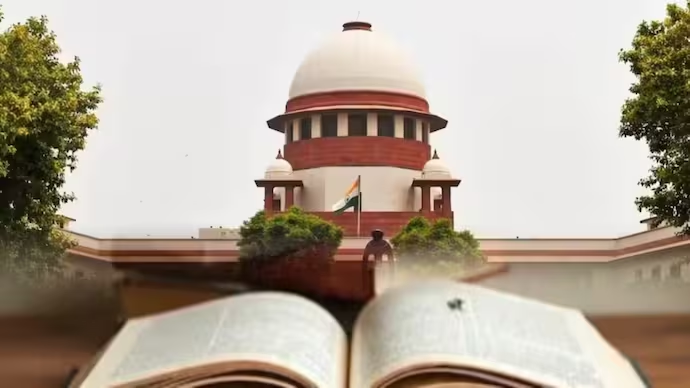
The ongoing Supreme Court–NCERT Row has triggered a serious national debate involving the Supreme Court of India, the National Council of Educational Research and Training (NCERT), and the Union Government. What began as a textbook controversy has now evolved into a larger discussion about constitutional dignity, civic education, and public trust.
The Supreme Court–NCERT Row started after a Class 8 Social Science textbook reportedly included references to corruption and systemic challenges within the Indian judiciary. The Supreme Court took strong objection to the tone and presentation of the content, stating that such references — especially when presented to young students — could damage the credibility of the judicial institution.
The Court reportedly took suo motu cognizance of the matter, meaning it initiated proceedings on its own without a formal petition.
Why the Supreme Court–NCERT Row Is Sensitive
The judiciary is one of the three pillars of Indian democracy. Public confidence in courts is essential for maintaining the rule of law. Any suggestion of “deep-rooted corruption” in school curriculum becomes highly sensitive because it directly affects how young citizens perceive the justice system.
At the same time, textbooks are designed to educate students about governance, accountability, and democratic functioning. This creates a delicate balance within the Supreme Court–NCERT Row:
- Protecting institutional dignity
- Encouraging critical and informed civic understanding
The controversy highlights the difficulty of teaching complex institutional realities at an early academic level.
The Larger Constitutional Question
The Supreme Court–NCERT Row is not limited to one chapter in one book. It raises broader questions:
- How should democratic institutions be discussed in school education?
- Should textbooks openly highlight institutional shortcomings?
- Or should such topics be introduced at a more mature academic stage?
This debate reflects deeper concerns about transparency, responsibility, and the limits of criticism in educational content.
In essence, the Supreme Court–NCERT Row is about finding the right balance between respect for constitutional institutions and the need for honest civic education.
Supreme Court’s Remark: Safeguarding Judicial Credibility
During the Supreme Court–NCERT Row, the Court made it clear that it views the issue as one of institutional integrity. Acting suo motu, the Bench reportedly expressed concern that the language used in the textbook could undermine public trust in the judiciary.
The Court emphasized that:
- The judiciary is a constitutional pillar and must not be portrayed in a way that weakens credibility.
- School-level curriculum must handle sensitive subjects with caution.
- Broad or generalized claims about corruption may create distrust in democratic systems at a young age.
The Supreme Court’s position in the Supreme Court–NCERT Row centers on preserving the dignity and authority of the judicial system.
Union Government’s Stand: Compliance and Corrective Action
In response to the Supreme Court–NCERT Row, the Union Government adopted a position of compliance and reform. Through the Ministry of Education, the government reaffirmed its full respect for the judiciary and indicated that the concerned content would be reviewed and revised.
The government’s approach includes:
- Reviewing and correcting the textbook content
- Conducting an internal examination of the drafting and approval process
- Strengthening review mechanisms for future publications
The Union Government has signaled that the Supreme Court–NCERT Row will be handled administratively, focusing on correction rather than confrontation.
Education, Democracy, and Institutional Trust
While the Supreme Court–NCERT Row appears to be an institutional disagreement, both sides ultimately underline the same principle — maintaining public trust in democratic institutions.
The Supreme Court seeks to safeguard judicial credibility.
The Union Government aims to ensure corrective action and curriculum reform.
This episode reminds us that education, law, and governance are deeply interconnected. How constitutional institutions are presented in classrooms today will shape public perception for generations.
The real challenge is not who is right or wrong in the Supreme Court–NCERT Row, but how India can strengthen civic education while preserving the dignity of its democratic pillars.


