

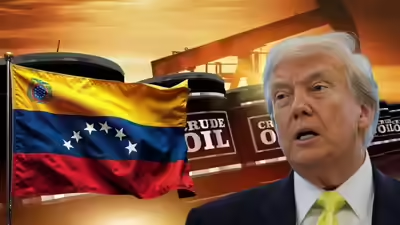
The alleged abduction of Nicolás Maduro, Venezuela’s elected president, along with his wife Cilia Flores, has triggered one of the most serious debates in modern geopolitics: does the principle of sovereignty still matter?
According to widely circulated but disputed accounts, the nightmare scenario long feared by Maduro became reality in the early hours of Saturday, January 3, 2026, around 2:00 AM Venezuela time. U.S. special forces, backed by approximately 150 aircraft, allegedly entered Venezuelan airspace, conducted rapid strikes in Caracas, and took the president and first lady into custody.
As of now, no confirmed casualty figures have been released by any independent or international authority.
If true, the operation would mark an extraordinary breach of international norms, raising urgent questions about the fate of sovereignty in a world dominated by great-power politics.
Why would the U.S. target a sovereign president?
The United States has long justified its hardline position against Maduro on three core grounds:
1. Sanctions and legitimacy
Since 2019, Washington has refused to recognize Maduro as Venezuela’s legitimate leader, backing opposition claims of electoral fraud. During his tenure, nearly eight million Venezuelans have fled the country amid economic collapse and political repression. The U.S. has repeatedly pressured Caracas to hold what it calls free and fair elections, presenting its stance as a defense of democracy.
2. Criminal allegations
U.S. authorities have accused Maduro of narco-terrorism and large-scale corruption, placing a $50 million reward for information leading to his arrest. Under the administration of Donald Trump, Venezuelan petroleum shipments were seized, further escalating tensions between the two countries.
3. Regional security
Washington argues that Venezuela under Maduro has become a destabilizing force in Latin America, citing mass migration, drug trafficking, and alleged ties with U.S. adversaries as direct threats to regional and American security.
The other side of the argument
While these allegations form the backbone of the U.S. position, critics argue that they represent only one side of a much larger and troubling pattern.
The United States, often presenting itself as the global guardian of democracy, has repeatedly intervened in sovereign nations under similar justifications, with consequences that continue to haunt entire regions.
- Panama (1989): Officially framed as a mission to protect democracy and U.S. interests, the invasion resulted in heavy civilian casualties and long-term political disruption.
- Iraq (2003): The claim that Saddam Hussein possessed weapons of mass destruction later proved false. The war dismantled the Iraqi state, triggered years of violence, and left millions dead or displaced.
- Afghanistan (2001–2021): After two decades of war, the U.S. withdrew abruptly, leading to the collapse of the U.S.-backed government and the return of the Taliban. Many Afghans who assisted U.S. forces were left behind, facing retaliation.
In each case, the promise of democracy was followed by prolonged instability, while accountability for long-term consequences remained absent.
The central question
Even critics of Maduro acknowledge that his government has committed serious abuses and failed millions of Venezuelans. Yet the core issue remains unresolved:
Does the failure of a leader justify the forced abduction of a sitting president of a sovereign nation?
If powerful states reserve the right to remove leaders unilaterally, international law risks becoming selective and transactional, applied only when convenient.
Conclusion
The Venezuela crisis is no longer only about Nicolás Maduro. It is about whether sovereignty still protects weaker nations, or whether power alone defines legitimacy in global affairs.
If the alleged U.S. operation is confirmed, it may set a precedent far more dangerous than the regime it claims to challenge—one where borders, ballots, and national self-determination can be overridden at will.


